AI for Local Retail: Compete with Amazon Without Amazon's Budget
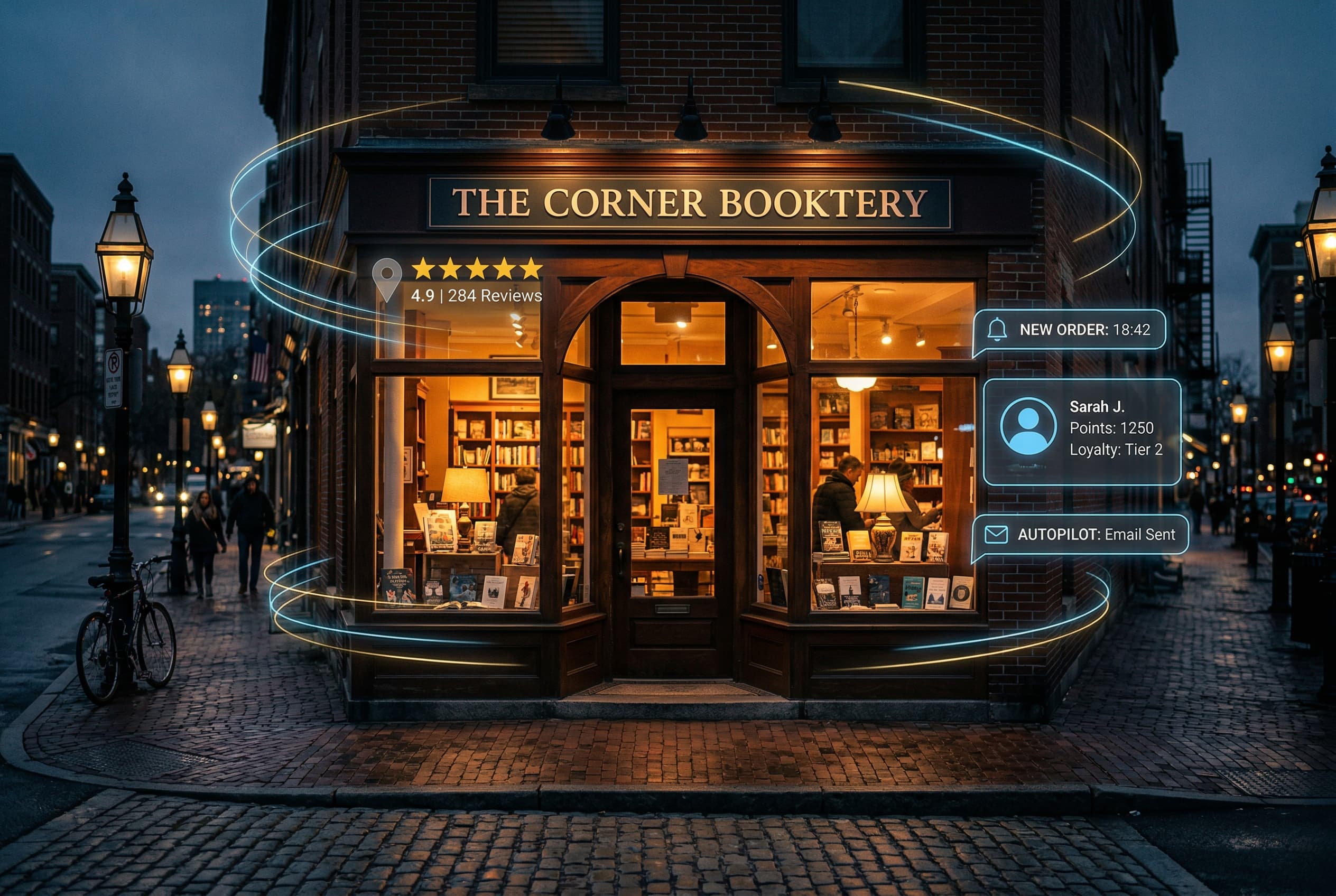
AI for Local Retail: Compete with Amazon Without Amazon's Budget
Let's start with the uncomfortable truth.
Amazon has thousands of engineers building recommendation algorithms. They have warehouses the size of small towns. They have same-day delivery, one-click purchasing, and a review ecosystem that practically runs itself. Their tech budget last year was somewhere north of $70 billion.
You have a shop, a small team (maybe just you), and the nagging feeling that the deck is stacked against you.
That feeling isn't wrong. The deck is stacked. Online retail now accounts for over 20% of all retail sales, and that number climbs every year. Big-box stores use sophisticated inventory systems and loyalty programs that would have seemed like science fiction a decade ago.
But here's what nobody talks about at the doom-and-gloom retail conferences: local retail isn't dying. Lazy local retail is dying. The shops that are thriving — really thriving — are the ones that lean into what makes them irreplaceable and use smart tools to handle everything else.
That's where AI comes in. Not as some futuristic gimmick. As the extra set of hands you desperately need but can't afford to hire.
You Have Something Amazon Never Will
Before we talk about technology, let's talk about your actual advantages. Because you have them, even if they don't feel like much when you're staring at another Prime Day announcement.
Relationships. Your regulars don't come in just because you have what they need. They come in because they know you. You remember their name. You remember that their kid just started college. You asked about their dog's surgery. Amazon will never — never — replicate that. Their algorithms can guess what you might want to buy. They cannot care about you.
Expert advice. You know your products. A customer walks in unsure about which running shoe fits their gait, which paint finish works for a bathroom, which gift a 12-year-old would actually like — and you guide them to the right answer in minutes. Amazon gives them 47,000 results and a prayer.
Instant gratification. Walk in, pick it up, walk out. No waiting for a box. No wondering if it's the right size. No porch pirates. The thing is in your hands now.
Community connection. You sponsor the little league team. You put local artists' work in your window. You're part of the fabric of the neighborhood. When people buy from you, they're investing in where they live. That matters to more people than you think.
The experience of browsing. There's a reason people still go to bookstores, record shops, and boutiques. Discovering something you didn't know you wanted, holding it in your hands, the smell of a store — that's not a transaction. It's an experience. Amazon is a vending machine. You're a destination.
These advantages are real. They're powerful. And they're yours.
The problem isn't that you lack advantages. The problem is that everything around those advantages — the marketing, the follow-up, the consistency — falls through the cracks because you're one person (or a small team) doing the work of an entire corporate department.
That's the gap AI fills.
AI Doesn't Replace Your Strengths — It Amplifies Them
Let's be clear about something: nobody is suggesting you replace the personal touch with a robot. The warm greeting, the product expertise, the genuine human connection — that stays. That's your superpower.
What AI does is handle the stuff you know you should be doing but can't get to. The follow-up email after a big purchase. The Google listing that hasn't been updated since 2023. The review you never asked for. The birthday offer you meant to send.
Amazon isn't beating you because their products are better. They're beating you on consistency. Every customer gets a follow-up. Every listing is optimized. Every review gets a response. Every purchase triggers the next smart touchpoint.
You don't need Amazon's budget. You need Amazon's consistency. AI gives you that.
Here are the five areas where it makes the biggest difference.
1. Google Business Profile Optimization: Win the "Near Me" Search
This is the single most neglected opportunity in local retail. Bar none.
When someone searches "gift shop near me" or "running shoes [your town]," Google decides who shows up in that map pack — the top three results that get the vast majority of clicks. The businesses that show up there aren't necessarily the best. They're the ones with the most active, optimized Google Business Profile.
That means:
- Accurate, complete information — hours, address, phone, website, categories, attributes
- Regular posts — Google treats your profile like a mini social media page. Businesses that post weekly get significantly more visibility
- Fresh photos — new product shots, store events, behind-the-scenes content
- Review responses — every single review, positive or negative, responded to thoughtfully and promptly
- Q&A management — answering customer questions that appear on your listing
Most local retailers set up their profile once and never touch it again. Meanwhile, their competitor down the street is posting every week and climbing the rankings.
AI changes this completely. It can generate and schedule weekly posts based on your inventory, seasonal events, and promotions. It can draft thoughtful responses to every review — you just approve and send. It can monitor your listing for accuracy and flag issues before they cost you traffic.
The result? You show up when it matters most: when someone nearby is actively looking for what you sell. That's not theoretical traffic. That's someone with their wallet out, looking for a store to walk into right now.
If you do nothing else on this list, do this one. Your Google Business Profile is your digital storefront, and for most local retailers, it's sitting there gathering dust.
2. Automated Email Campaigns: Your Customer List Is Gold
Here's something that will make you want to kick yourself: you're probably sitting on a goldmine and ignoring it.
Your customer list — the emails you've collected from purchases, loyalty sign-ups, events, even that fishbowl on the counter — is one of the most valuable assets your business owns. These are people who have already bought from you. They already trust you. Getting them to come back is dramatically easier and cheaper than finding new customers.
But most local retailers never email their list. Or they send one blast at Christmas and call it a year.
AI-powered email automation changes the game:
Birthday and anniversary offers. Imagine every customer getting a personalized discount on their birthday, automatically. No spreadsheet tracking, no manual sending. It just happens. And the redemption rates on birthday emails are through the roof — people love feeling remembered.
New arrival alerts. Got a fresh shipment of that brand your regulars love? AI can segment your list and notify exactly the right people. Not a mass blast — a targeted heads-up to the customers who actually care.
"We miss you" win-backs. Someone who used to shop with you every month hasn't been in for 90 days? An automated, warm email goes out: "Hey, we've missed seeing you! Here's 15% off your next visit." It sounds simple because it is. And it works.
Post-purchase follow-ups. Someone buys a winter coat? Three months later, they get a note about your new spring collection. Someone buys a gift? A few weeks before the next gifting holiday, they get a reminder with suggestions. This is the kind of thoughtful follow-through that builds lifelong customers — and it runs on autopilot.
The key insight here: this isn't about blasting people with spam. It's about being thoughtful at scale. The same thoughtfulness you'd show in person, extended to every customer, every time, without you having to remember a thing.
3. Inventory Management Alerts: Buy Smarter, Not Harder
Every dollar tied up in dead inventory is a dollar you can't spend on what's actually selling. And most local retailers make buying decisions based on gut feeling, habit, or whatever the sales rep talked them into last time.
AI-powered inventory management doesn't require a fancy system. Even basic AI tools can analyze your sales data and tell you:
- What's selling fast — so you can reorder before you're out
- What's sitting — so you can run promotions to move it before it's truly dead
- Seasonal patterns — so you can buy smarter for next year based on what actually happened this year
- Margin analysis — which products are actually making you money versus just generating revenue
This isn't about replacing your instincts. You know your customers and your market. But your instincts backed by data? That's a different level. You stop over-ordering the stuff that looked good in the catalog but collected dust on the shelf. You start doubling down on the winners earlier.
One boutique owner we talked to said she was spending roughly 20% of her buying budget on inventory that ended up in the clearance bin every season. After implementing basic AI-driven inventory alerts, that number dropped to under 8%. That's not a small difference. That's rent money.
4. Loyalty Program Automation: Reward Your Regulars Without the Headaches
You know your regulars are your lifeblood. They account for a disproportionate share of your revenue, they refer friends, and they're the reason your shop has a heartbeat.
But running a loyalty program manually is a nightmare. Punch cards get lost. Points get forgotten. Reward thresholds are confusing. And the referral program you meant to launch? Still on the to-do list from last year.
AI automates the entire thing:
Points tracking and communication. Every purchase earns points. Customers get automatic updates on their balance and how close they are to their next reward. No paper cards, no "I forgot my punch card" headaches.
Reward triggers. Hit 500 points? An automatic email or text goes out with their reward. No staff member has to remember, no customer has to ask.
Referral programs. "Send this to a friend, you both get $10 off." AI tracks the referral, applies the discount, and sends the thank-you. The entire program runs itself after initial setup.
VIP tiers. Your top 10% of customers could get early access to new arrivals, exclusive events, or special discounts. AI identifies them automatically based on purchase history and enrolls them. These customers feel valued because they are valued — and now the system reflects it.
Loyalty programs aren't new. But loyalty programs that run themselves, communicate consistently, and actually make customers feel appreciated? That's what AI makes possible for a one-person shop with zero IT staff.
5. Review Collection: Turn Happy Customers Into Your Marketing Team
Here's a stat that should keep you up at night: 87% of consumers read online reviews for local businesses. And the difference between a 3.8-star rating and a 4.5-star rating isn't just vanity — it's the difference between someone walking into your store or driving past it.
The frustrating part? Most of your customers are happy. They'd probably leave a positive review if asked. But asking feels awkward, the timing is never right, and you forget in the rush of running the store.
AI solves this with systematic, well-timed review requests:
Post-purchase timing. A day or two after a purchase, an automated text or email goes out: "Thanks for shopping with us! If you had a great experience, we'd love a quick review." It includes a direct link — one tap, they're on your Google review page.
Smart filtering. Good AI review systems ask a quick sentiment check first. Happy customer? Directed to Google. Unhappy customer? Directed to you privately, so you can fix the problem before it becomes a public complaint.
Consistency. This is the killer. You don't ask once and forget. Every customer gets asked. Not just the ones you remember to mention it to on a good day. Over time, this builds a review volume and velocity that Google's algorithm loves — which feeds back into your search rankings.
One local retailer we spoke with went from 45 Google reviews to over 300 in eight months, with their average rating climbing from 4.2 to 4.7. They didn't do anything differently in the store. They just started asking, every time, automatically.
Your happy customers are your best marketing team. AI just gives them the microphone.
The Real Formula: Personal Touch + Automation
Let's zoom out for a second.
Amazon's advantage was never about having better products. It was about systems. Systems that follow up, that remember, that optimize, that never forget, that never have a bad day, that never get busy and skip the important stuff.
For years, those systems were only available to companies with engineering teams and million-dollar budgets. That's not the case anymore.
AI gives you the systems. You provide the soul.
Think about it: the local shop that knows your name, remembers your preferences, gives expert advice, AND follows up with a birthday discount, AND responds to every review within 24 hours, AND shows up at the top of Google when someone searches "near me," AND sends you a heads-up when your favorite brand drops new product?
That shop is unstoppable. Amazon cannot compete with that combination. Big-box stores cannot compete with that combination. Because it requires two things: genuine human connection AND relentless automated consistency. Amazon has the second but will never have the first. Most local retailers have the first but struggle with the second.
AI bridges that gap.
You Don't Have to Do It All at Once
If this feels like a lot, take a breath. You don't need to implement all five things tomorrow.
Start with one. The Google Business Profile is the highest-impact, lowest-effort starting point for most retailers. Get that dialed in. See the results. Then add email automation. Then reviews. Build momentum.
The goal isn't to turn your shop into a tech company. The goal is to stop letting opportunities slip through the cracks so you can focus on what you do best: taking care of your customers.
Take the Next Step
Not sure where to start? We built a free assessment that looks at your specific business and tells you exactly where AI can make the biggest impact.
Take the free assessment — it takes five minutes, and you'll walk away with a prioritized action plan.
Already know you want to move forward? Get the Retail Playbook — a step-by-step guide to implementing AI automation in your local retail business, written in plain English.
Amazon has a $70 billion tech budget. You have something better: customers who actually want you to succeed. AI just helps you show up for them, every single time.
Ready to Put AI to Work?
Take our free assessment to find out which automations will have the biggest impact on your business.