The Contractor's Guide to AI: Stop Losing $300K/Year to Missed Calls
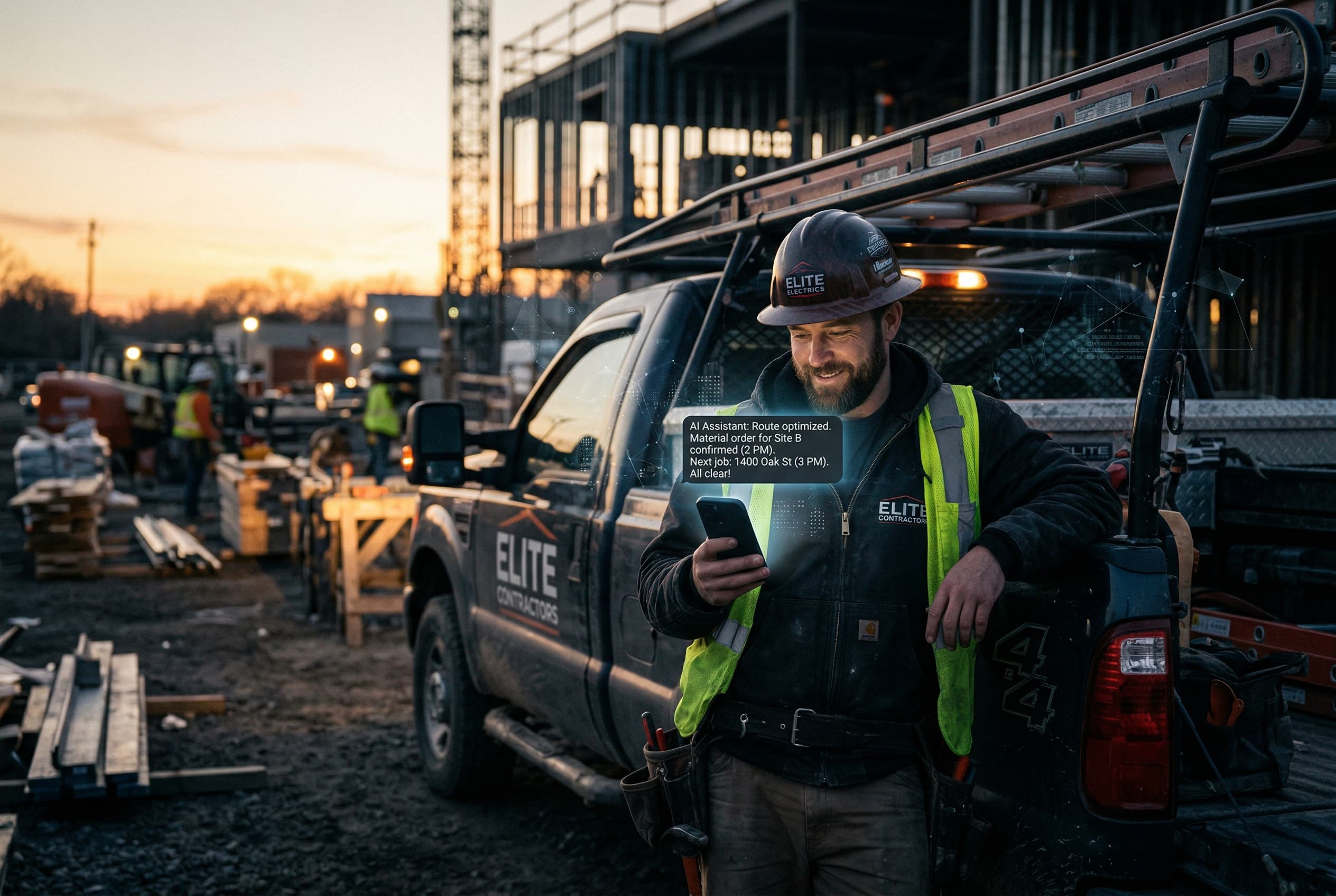
Picture this. You're under a house, crawling through a crawl space, replacing a section of pipe. Your phone buzzes in your pocket. You can't answer — your hands are covered in PVC cement and you're wedged between a floor joist and a drain line.
By the time you crawl out, clean up, and check your phone, it's been 22 minutes. You call back. No answer. That homeowner already called the next plumber on Google. They already booked someone else.
That job? It was a full bathroom remodel. $8,500.
Gone.
This happens every single day to contractors across the country. Not because they're bad at their jobs — because they're too busy doing their jobs to answer the phone.
The $300K Problem Nobody Talks About
Here's the math, and it's ugly.
The average contractor misses 40% of incoming calls. That's not a guess — that's data from call tracking across thousands of service businesses. Almost half of the people trying to give you money can't reach you.
Now, the average service call for a contractor — plumbing, electrical, HVAC, roofing, general contracting — is worth about $1,200. Some are smaller. Some, like that bathroom remodel, are much bigger. But $1,200 is a solid average across the trades.
Let's say you get 5 calls a day. That's modest for any contractor who's been around a few years and has decent Google reviews. Five calls a day, five days a week, 50 weeks a year.
That's 1,250 calls per year.
Miss 40% of them? That's 500 missed calls.
At $1,200 each? That's $600,000 in potential revenue that never even got a chance.
Now, not every missed call would have converted to a job. Let's be conservative and say half of those callers would have booked if you'd answered. That's still $300,000 per year walking out the door because nobody picked up the phone.
Three hundred thousand dollars. Every year. Just sitting on the table.
And here's what makes it worse: you don't even know it's happening. You don't see the money you didn't make. You just wonder why growth feels so hard when you're doing good work and your reviews are solid.
Why "Just Hire a Receptionist" Doesn't Fix It
The obvious answer is to hire someone to answer the phone. And sure, that works — sort of.
A full-time receptionist costs $35,000-$45,000 a year with taxes and benefits. They work 8 hours a day, 5 days a week. They take lunch breaks, sick days, and vacations. They don't answer at 7 PM on a Tuesday when a homeowner's pipe just burst.
A phone answering service is cheaper, maybe $300-$800 a month. But those services take a message and send it to you. The customer still has to wait for a callback. And in the time it takes you to finish the job you're on and call back? They've already booked someone else.
The problem isn't just answering the phone. The problem is keeping the customer engaged in the 5 to 60 minutes between when they call and when you can actually talk to them.
That's where AI comes in. And not the sci-fi, robot-taking-your-job kind of AI. The practical, boring, incredibly profitable kind.
5 AI Automations That Actually Work for Contractors
These aren't theoretical. These are systems that real contractors are running right now. None of them require you to be "tech-savvy." None of them require you to stare at a computer. They run in the background while you do what you do best — the actual work.
1. Missed Call Text-Back
What it does: The moment someone calls and you don't answer, they instantly get a text message. Something like: "Hey, this is [Your Company]. Sorry we missed your call — we're on a job right now. What can we help you with?"
How it works: You connect your business phone number to an automation platform. When a call goes unanswered after a set number of rings, the system fires off a text within seconds. No human involved. No delay.
Why it matters: Here's human psychology at work. When someone calls a contractor and gets voicemail, their next move is to hang up and call the next name on the list. But when they get a text back immediately, something shifts. They think, "Oh, they're just busy working. They got my message." They respond to the text. They stop calling other contractors.
You've gone from "didn't answer, moving on" to "they're responsive, I'll wait."
Realistic ROI: Let's say this saves you just 3 jobs per month that would have otherwise gone to a competitor. At $1,200 average, that's $3,600/month — $43,200/year. The automation costs maybe $100-$200/month to run. That's a 20x return.
And 3 saved jobs per month is conservative. Most contractors who set this up are stunned by how many text conversations it starts.
2. Automated Scheduling
What it does: After that initial text conversation, the customer can book an appointment directly — no phone tag, no "let me check my schedule and call you back."
How it works: The text-back message includes a link to your calendar. The customer picks a time slot that works for them. It goes on your calendar. You get a notification. Done.
No back-and-forth. No "I called them back but they didn't answer, so I left a message, and now I'm waiting again." The whole dance is eliminated.
Why it matters: Phone tag kills deals. Every round of "I called, they didn't answer, they called back, I was busy" increases the chance the customer gives up and books someone else. Automated scheduling compresses what used to be 3-4 phone calls over 2 days into a single text interaction that takes 90 seconds.
Realistic ROI: This one's harder to put a single number on because it works together with the missed call text-back. But think about it this way: how many hours per week do you spend on the phone just scheduling appointments? Most contractors say 5-10 hours. What's your time worth per hour? If you bill at $150/hour and save 7 hours a week, that's $1,050/week in recovered productive time. Over $54,000 a year.
Plus, customers love it. They can book at 10 PM on a Sunday. They don't have to wait until Monday morning. They don't have to remember to call you back. They just... book.
3. Quote Follow-Up Sequences
What it does: After you send a quote, the system automatically follows up with the customer on a set schedule — checking if they have questions, reminding them the quote is still valid, and nudging them toward a decision.
How it works: You send a quote like you normally do. The system knows a quote was sent (either because you mark it in your CRM or because it integrates with your quoting tool). Then it sends a series of follow-up messages:
- Day 2: "Hey [Name], just wanted to make sure you got the estimate we sent over. Any questions?"
- Day 5: "Hi [Name], checking in on that [project type] estimate. Happy to walk through any of the line items if it'd be helpful."
- Day 10: "Hey [Name], just a heads up — we've got some availability opening up next week. If you'd like to get on the schedule, now's a good time."
Why it matters: This is the big one that most contractors completely ignore. Here's what usually happens: you go to a customer's house, spend 45 minutes looking at the job, drive back to the office, spend 30 minutes writing up the quote, email it over... and then pray.
You never follow up. Or you follow up once, awkwardly, two weeks later. By then, the customer has either booked someone else or put the project on the back burner indefinitely.
The data on this is clear: 80% of sales require 5+ follow-ups, but 44% of salespeople give up after one. Contractors are even worse — most give up after zero follow-ups. They just send the quote and move on to the next job.
Automated follow-up closes the gap without you having to remember anything or feel awkward about "bugging" people.
Realistic ROI: If you send 20 quotes a month and automated follow-up converts just 2 additional jobs that would have otherwise gone cold, that's $2,400/month at $1,200 average. That's $28,800/year. And honestly, 2 out of 20 is a modest improvement — many contractors see follow-up increase their close rate by 15-25%.
4. Automated Review Requests
What it does: After you complete a job, the system automatically sends the customer a friendly message asking them to leave a Google review — with a direct link that takes them right to the review page.
How it works: When a job is marked complete (or a set number of days after the appointment), the customer gets a text: "Thanks for choosing [Your Company]! If you're happy with the work, we'd really appreciate a quick Google review. It helps other homeowners find us: [link]"
Simple. Direct. No asking in person (which most contractors find uncomfortable). No forgetting (which happens 90% of the time).
Why it matters: Google reviews are the single biggest factor in whether a homeowner calls you or your competitor. Not your website. Not your truck wrap. Not your Facebook page. Your Google reviews.
A contractor with 150 reviews and a 4.8 rating will get 3-5x more calls than a contractor with 12 reviews and a 4.9 rating. Volume matters more than perfection. And the only way to get volume is to ask consistently — which means automating it.
Realistic ROI: This one compounds over time. More reviews means higher Google ranking means more calls means more jobs. A contractor who goes from 30 reviews to 150 reviews over a year can realistically see a 30-50% increase in inbound calls. On a business doing $500K/year, that's $150,000-$250,000 in additional revenue. All from a system that costs virtually nothing to run.
Even in the short term, just going from 30 to 60 reviews in 3 months can meaningfully change your call volume. And every single review is a free advertisement that works for you 24/7/365.
5. Automated Social Media Posting
What it does: AI takes your job photos, before-and-after shots, or quick descriptions of completed work and turns them into social media posts — then publishes them to your Google Business Profile, Facebook, Instagram, or wherever your customers are.
How it works: You snap a photo of a finished job (you probably already do this). You drop it into a shared folder or send it to a dedicated number via text. The AI writes a caption, formats it for each platform, and posts it on a schedule. Some systems can even create posts from scratch based on the type of work you do.
Why it matters: Two things are happening here. First, an active Google Business Profile with regular posts ranks better in local search. Google rewards businesses that show signs of life. A profile with weekly posts will outrank a dormant one, all else being equal.
Second, social proof. When a homeowner is deciding between two contractors, they'll check Facebook or Instagram. If your page has a post from yesterday showing a beautiful kitchen install, you feel current and active. If your last post is from 8 months ago, you feel like you might not even be in business anymore.
But here's the reality: no contractor has time to write social media posts. You're not going to sit down at 9 PM after a full day of physical labor and craft the perfect Instagram caption. That's why AI does it for you.
Realistic ROI: Hard to isolate, but improved local search ranking and social proof contribute to the same call volume increase as reviews. Think of it as a multiplier on everything else. Combined with reviews, an active social and Google presence can drive 20-40% more inbound leads over 6-12 months.
"I'm Not a Tech Person"
Good. You're not supposed to be.
If you had to learn software, manage dashboards, write prompts, or troubleshoot integrations, this wouldn't be worth your time. The whole point is that these systems run on autopilot.
You do your job. The AI handles the rest. You don't need to understand how it works any more than you need to understand how your GPS works to drive to a job site.
When we set these systems up, we build them, test them, and hand them over working. You go about your day. Your phone stops being a liability and starts being a machine that captures every dollar of opportunity that comes your way.
That said — you should know what's running. You should be able to see the results. And you should be able to call someone when something needs adjusting. That's the difference between a real automation partner and a software subscription that leaves you on your own.
This Isn't Theoretical — Here's Proof
We built an entire business operation for N1 Wellness using AI agents. Not just one or two automations — a complete system: 2 websites, 30 products, 38 automations, 121+ images, email sequences, review management, social posting, the works.
The cost? About $400 to build and $130/month to run.
The equivalent cost with a traditional team — designers, developers, copywriters, social media managers, project managers? $298,000 and 7 months of work.
We did it in 5 days.
You can read the full breakdown in our case study. The point isn't the specific numbers — it's that AI automation has gotten to the place where small businesses can operate with the same sophistication as companies 10x their size, at a fraction of the cost.
For contractors specifically, you don't need the full N1 Wellness treatment. You need the 5 systems above. They're simpler, faster to deploy, and they start paying for themselves in the first week.
The Real Cost of Waiting
Every month you put this off, you're leaving $25,000+ on the table. That's not dramatic — it's math.
500 missed opportunities a year. Quotes going cold. Reviews not getting asked for. Your Google presence collecting dust while the competitor down the road shows up with 200 reviews and weekly posts.
The contractors who move on this now are going to dominate their local markets for the next 5 years. The ones who wait will wonder why it keeps getting harder to compete even though their work is just as good.
This isn't about replacing you. It's not about making your business "techy." It's about plugging the holes that are draining revenue from a business that's already doing great work.
You're leaving money on the table. The fix is straightforward. And it doesn't require you to change a single thing about how you do your actual job.
See What's Possible for Your Business
Not every contractor needs all five automations on day one. Some are losing the most money to missed calls. Others have the call problem handled but are bleeding out on quote follow-up. Some have great reviews but zero social presence.
The right starting point depends on where your biggest leak is.
Take our free AI assessment — it takes about 3 minutes and shows you exactly which automations would have the biggest impact on your specific business. No sales pitch, no commitment. Just a clear picture of where you're leaving money on the table and what to do about it.
Want the full playbook first? Get the Contractor AI Playbook — a straightforward breakdown of how to implement each of these systems, what they cost, and what to expect in terms of results.
You didn't get into contracting to be a marketing expert or a tech wizard. You got into it because you're good at what you do. Let the AI handle the business side so you can focus on the work.
Your phone is ringing right now. The only question is whether you're catching those calls — or letting them walk out the door.
Ready to Put AI to Work?
Take our free assessment to find out which automations will have the biggest impact on your business.