What Your Customers Already Expect in 2026 (And You Are Not Delivering)
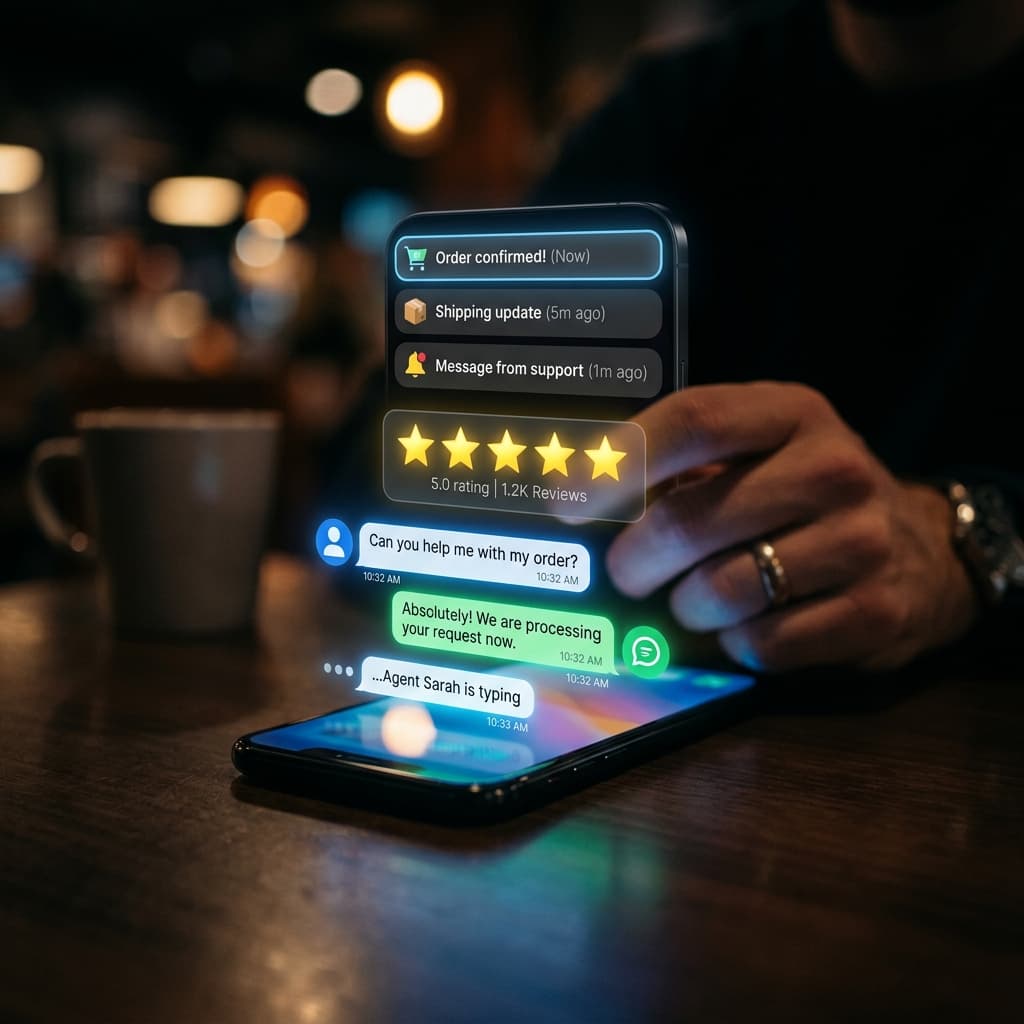
Your customers aren't comparing you to the other plumber on the street or the shop two towns over. They're comparing you to Amazon.
That's not hyperbole. Every time someone places an order and gets a confirmation text in 30 seconds, watches a delivery tracker update in real time, and receives a follow-up survey the next day — their brain recalibrates what "normal" looks like. Every Uber ride with a real-time map and instant receipt. Every DoorDash order with a live driver tracker. Every Chewy subscription with an auto-refill reminder.
These companies spent billions training your customers to expect instant, personalized, 24/7 communication. And then your customers call your business — and they get voicemail.
This isn't a technology article. It's a market reality article. The expectations are already set. The question is whether your business meets them or loses customers to one that does.
How Amazon Broke Every Small Business's Customer Service
Think about the last time you ordered something online and the confirmation email arrived in 45 minutes. What did you do? You probably called the company to make sure the order went through.
Now think about what happened the last time you ordered from Amazon. You got a confirmation email in 90 seconds. A shipping notification the same day. A delivery estimate. A "your package is 5 stops away" alert. A "your package was delivered" text with a photo. A follow-up asking if everything arrived in good condition.
You didn't think about any of that consciously — because it all happened the way you expected. No surprises, no gaps, no anxiety. That's what Amazon trained people to feel when a transaction goes smoothly.
Now your HVAC customer submits a contact form on your website at 7 PM on a Tuesday. They've got no AC in July and they're already stressed. By 11 PM, with no response from you, they've contacted two other companies and booked whoever responded first.
You didn't lose that customer because your service was worse. You lost because your customer experience couldn't match the expectation that Amazon set for them — instant confirmation that someone received their message and is on it.
This is the competitive landscape in 2026. You're not fighting other HVAC companies on service quality. You're fighting a baseline expectation of responsiveness that was created by trillion-dollar tech companies. And most small businesses are losing that fight without even knowing it's happening.
The 5-Minute Rule That's Costing You $10,000+ Per Month
Here's a number worth tattooing somewhere: 78%.
That's the percentage of customers who go with the first business that responds to their inquiry, according to data from Harvard Business Review and replicated across dozens of follow-up studies. First to respond wins. Not best quality. Not lowest price. First.
Now here's the follow-up number: leads contacted within 5 minutes are 21 times more likely to convert than leads contacted after 30 minutes.
Twenty-one times.
This isn't a small difference. It's not something you can overcome with a better sales pitch or a lower quote. By the time you return a call four hours later, the lead has moved on and isn't coming back. You're not in second place — you're not even in the conversation.
What This Costs You in Real Money
Let's run the math for a typical service business — say, a plumber pulling in $300,000/year.
You generate roughly 100 leads per month. About 40% arrive outside business hours — evenings, weekends, lunch breaks. That's 40 leads per month getting a delayed response. Based on the conversion data, you're losing approximately 30 of those 40 leads to competitors who respond faster.
Average job value: $400. That's $12,000 per month in lost revenue. $144,000 per year. Nearly half your annual revenue, evaporating because your phone went to voicemail after 5 PM.
And those numbers are conservative. They don't account for the referrals you'd have gotten from those jobs, or the repeat business from those customers over the next 3–5 years.
The 5-minute rule is ruthless. And right now, it's costing most small businesses more than any other single problem they have.
The Review Gap That Makes You Invisible
Before a customer calls you, they already have an opinion of you.
They've looked at your Google listing. They've scanned your reviews. And here's the ugly truth: if you have fewer than 50 reviews, a large portion of potential customers have already moved on without ever picking up the phone.
A 2025 BrightLocal study found that 98% of consumers read online reviews for local businesses, and 79% trust online reviews as much as personal recommendations from friends. More importantly, 57% of consumers won't use a business with fewer than 4 stars, and review recency matters enormously — customers trust reviews posted in the last 3 months far more than reviews from a year ago.
The Compounding Review Problem
Here's where it gets painful. Reviews aren't just social proof — they're a primary ranking factor for Google's local search algorithm. More reviews, higher recency, and better ratings mean your business shows up higher in the map pack when someone searches "plumber near me" or "best auto body shop in [city]."
If you have 18 reviews and your competitor has 180, your competitor shows up in searches you never see. Customers who would have loved your work never find you. It's not just about persuading people who already found you — it's about existing in the first place.
Now consider how reviews accumulate. Without a systematic approach, most businesses get 1–3 reviews per month, usually from the most enthusiastic customers or the most angry ones. The satisfied middle doesn't leave reviews — not because they didn't have a good experience, but because no one asked them at the right moment.
With an automated review request — a text sent 24 hours after a job is completed, at the exact moment customer satisfaction peaks — that same business generates 15–25 reviews per month. Every month. Consistently. Without anyone thinking about it.
Twelve months later, your competitor has 200 new reviews. Your Google ranking is so far below theirs that you're paying for ads to show up in a position they're getting for free.
The review gap is a search visibility gap. And search visibility is revenue.
Texting: The Channel Your Customers Prefer That You're Ignoring
Email open rates for small businesses average around 20–25%. Text message open rates are 98%, with most texts read within 3 minutes of receipt.
This isn't a close comparison. Texts get read. Emails get buried.
Your customers know this. Most of them already prefer texting for appointment reminders, confirmations, and quick communications. A 2025 customer communication survey found that 67% of consumers prefer to receive business communications via text rather than email or phone call — and that preference is even higher in the 25–55 age range that makes up the bulk of most local service business customers.
And yet the vast majority of small businesses are still operating on a phone-call-and-email model that was standard in 2010.
What Customers Experience When You Text vs. When You Don't
When you text:
- Appointment confirmed at 9:32 AM via text
- Reminder sent 24 hours before with the tech's name
- "Tech is 20 minutes away" notification day-of
- "Thank you — did everything go well? We'd love a review." 24 hours after the job
- Six months later: "Your HVAC filter is due for a change — want to book a quick service visit?"
The customer feels taken care of. Informed. Not forgotten.
When you don't text:
- Customer calls to confirm the appointment they're not sure is on the calendar
- Sits at home for a 4-hour window wondering if anyone is coming
- Never gets a follow-up
- Forgets your name by the time they need the service again
Same quality of work. Completely different experience. Completely different likelihood of getting a 5-star review, repeat business, and a referral.
Texting is table stakes in 2026. If you're not doing it, you're providing a worse experience than a competitor with identical skills just because they use a better communication tool.
Personalization: The Difference Between Feeling Known and Feeling Like a Number
Pull up your phone. How many of these have you received in the last month?
"Hi! Time to schedule your next appointment. Call us today!"
They went straight to your deleted folder, right? Of course they did. They're generic, they're easy to ignore, and they feel exactly like what they are — a business treating you as a unit in a spreadsheet rather than a person with a specific history.
Now read this:
"Hi Sarah — this is Oak Street Auto. You came in last April for brake work on your 2021 Civic. Based on your mileage at that visit, you're probably getting close to needing an oil change. Want us to set up a quick 30-minute slot? We have Tuesday afternoons open this week."
Same goal — get the customer to book an appointment. Completely different effect. That second message works because it demonstrates that the business knows Sarah, knows her car, and has done the math on her behalf. It respects her time. It shows she's not just a name in a database.
Why Personalization Converts
Personalized communication drives measurably better outcomes across every metric that matters:
- Open rates for personalized texts and emails run 40–60% higher than generic messages
- Click-through rates are 2–3x higher when the message references specific customer history
- Conversion rates improve 15–30% when the customer feels the communication was created specifically for them
This isn't intuition — it's documented in marketing research going back years, and the gap keeps widening as customers get better at filtering out generic communication.
The paradox of personalization is that customers now expect it even though most businesses can't deliver it manually. A shop serving 500 customers a month can't write personalized messages to each of them. But AI can — and does.
What AI Actually Does: Closing the Gap, All at Once
Here's the thing about the five gaps we've covered — slow response, no reviews, no texting, no personalization, and the general sense that your business goes dark after 5 PM:
Each one individually would be a manageable problem. Together, they create an experience gap that loses customers to competitors who have better operations, not necessarily better service.
AI closes all of them simultaneously. Not sequentially. Not eventually. All of them, from day one.
How It Works in Practice
When a lead comes in at 10 PM on a Saturday — your phone rings, the call goes to voicemail, and before the customer can decide to call someone else, they get a text:
"Hey, this is Jake from Summit Plumbing — I saw you just called. I'm on a job right now but wanted to reach back. What's going on? I can get you scheduled for first thing Sunday or Monday morning."
The lead responds. The AI collects the details, checks the calendar, and confirms the appointment. Sunday morning, Jake gets to the job with the customer's issue already documented. The customer shows up having been reminded twice. After the job, they get a personalized thank-you text referencing the specific problem Jake fixed, with a review request linked directly to the Google listing.
Jake didn't do any of that. His AI system did. He just showed up and did the plumbing.
The 24/7 Reality
AI doesn't sleep. It doesn't have weekends. It doesn't have vacations. It responds at 11:43 PM on Christmas Eve with the same speed and professionalism it responds at 9 AM on a Tuesday.
For businesses in service industries where emergencies don't respect business hours, this is a structural advantage. Plumbers. Electricians. HVAC techs. Locksmiths. Emergency pet care. Auto repair. The businesses that can respond instantly at any hour capture leads that everyone else loses.
For businesses that don't deal in emergencies, 24/7 availability still matters because customers browse, research, and make decisions outside business hours. If a customer is deciding between two landscapers at 9:30 PM and one of them texts back in 90 seconds while the other is closed — the 90-second response wins.
The Cost Comparison
A part-time receptionist works 20 hours per week, handles calls during business hours, has no system for follow-up or reviews, and costs $18,000–$24,000 per year in wages plus payroll overhead.
AI automation covers 24/7 response, automated review generation, personalized follow-up sequences, appointment reminders, and reactivation campaigns — for $300–$600 per month. Under $7,200 per year. And it handles unlimited volume without burning out.
This isn't a marginal improvement. It's a fundamental shift in what's possible for a small business operating on a small budget.
The Gap Is Growing Every Month
The customer expectation gap — the distance between what your customers expect and what most small businesses deliver — isn't static. It's widening.
Every time a customer uses a tech-enabled service that delivers a seamless, instant, personalized experience, their baseline expectation moves up. Every month that AI adoption grows among your competitors, the businesses that haven't adopted AI fall further behind the new standard of customer experience.
In January 2025, a same-day text response to an evening inquiry was a pleasant surprise. In March 2026, a 4-hour callback is a reason to leave a 2-star review about responsiveness. In January 2027, a business that doesn't send appointment reminders and review requests will feel amateurish to customers who have gotten used to those things everywhere else.
You don't get credit for meeting yesterday's standard. You're measured against today's.
What Your Competitors Are Already Doing
Right now, in your market, there is almost certainly at least one competitor who has already deployed AI automation. They're responding to inquiries in under 60 seconds, 24 hours a day. They're generating 20–30 reviews per month. Their appointment reminders go out automatically. Their Google ranking is climbing while yours is flat or declining.
You may not see it yet. They're not advertising it. But their numbers are changing — more inbound leads, better conversion rates, higher review counts, better search visibility. In 6–12 months, the advantage will be visible. In 18 months, it may be insurmountable.
The window to adopt AI before it becomes a significant competitive disadvantage is not permanently open.
What to Do Right Now
This is where most articles like this get vague. Not this one.
There are two steps, and neither requires you to understand AI or have a technology background.
Step 1: Figure out where your biggest gap is.
Take a hard look at your current operations:
- How long does it take you to respond to inquiries outside business hours?
- How many reviews does your Google listing have — and how many did you generate this month?
- Do you send appointment reminders? Via text or phone?
- When a customer doesn't book immediately, do you follow up? How many times?
- Have you reached out to customers from 6 months ago to bring them back?
Be honest. Most small businesses will answer "hours," "not many," "no," "once or never," and "no" to those questions. That's the gap.
Step 2: Start closing it.
You don't need to solve all of it at once. Pick the highest-impact item for your business and close that gap first. For most service businesses, that's after-hours response — because that's where the most revenue is bleeding out right now.
If you want a structured analysis of your specific situation — where you're losing the most, what AI would do for your type of business, and what it would cost — the AI Readiness Assessment does exactly that in about 10 minutes. It's free, it requires no commitment, and the output is genuinely useful whether you end up working with us or not.
The Bottom Line
Your customers aren't asking for a lot. They want to know you got their message. They want to feel like you know who they are. They want a text they'll actually read instead of an email they won't. They want to feel taken care of before, during, and after the transaction.
These aren't unreasonable expectations. They're baseline expectations that have been set by the digital experiences your customers have every day.
AI automation delivers all of it — instantly, consistently, 24/7 — at a cost that's a fraction of hiring someone to try to do it manually. The gap between what customers expect and what most small businesses deliver is real. It's measurable. And it's closing deals for your competitors right now.
The question is whether you close the gap before your customers find someone who already has.
Ready to see exactly where you're losing customers?
The Free AI Readiness Assessment takes 10 minutes and shows you precisely where AI automation would have the biggest impact on your specific business — which leads you're losing, which reviews you're not getting, and what it would take to fix it.
If you want a deeper look at how to build AI into your operations step by step, download the Runwa Small Business AI Playbook — a practical, no-fluff guide to implementing AI automation without a tech team or a big budget.
Ready to Put AI to Work?
Take our free assessment to find out which automations will have the biggest impact on your business.