Your Competitor Is Using AI. You're Not. Here's What Happens Next.
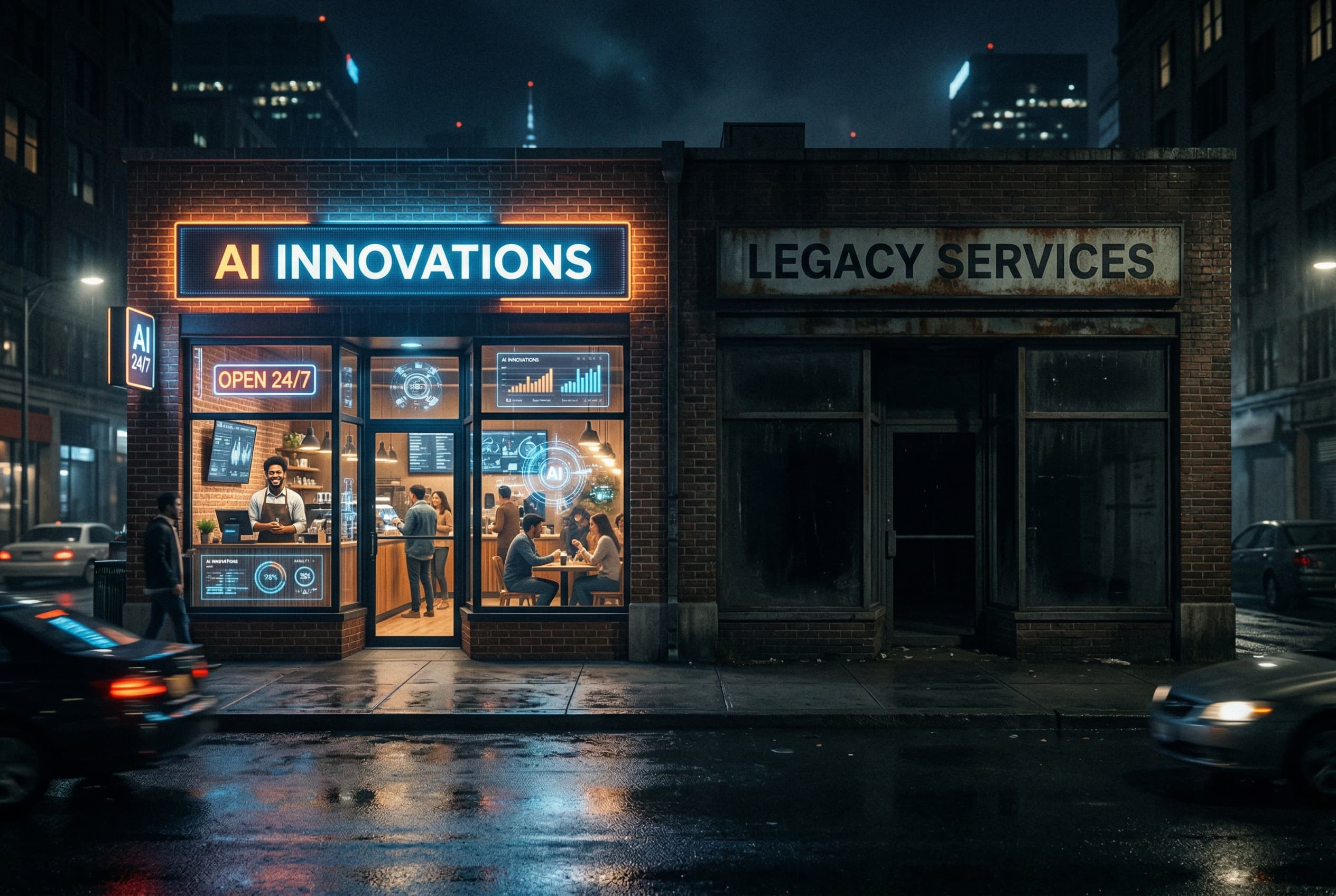
This isn't a scare tactic. It's arithmetic.
When one business responds to leads in 30 seconds and another responds in 4 hours, the first business wins. Not because they're better at their craft. Not because they have more experience. Not because they care more. They win because they showed up first.
AI is making this gap wider every month. And the businesses on the wrong side of that gap are starting to feel it.
The Uncomfortable Truth About AI Adoption
Let's look at what's actually happening in 2026.
According to recent surveys, 47% of small businesses are now using some form of AI automation — up from 23% in early 2025. That's not a trend. That's a tidal shift.
But here's what matters more than the headline number: the businesses that adopted AI early aren't just keeping pace. They're pulling ahead. They're capturing more leads, generating more reviews, spending less time on repetitive tasks, and — critically — delivering a customer experience that manual businesses can't match.
This isn't about being a tech company. This isn't about hiring developers. The plumber down the street who set up AI text-back six months ago isn't a tech visionary. He's just a business owner who decided to stop losing leads at 9 PM on a Tuesday.
Concrete Examples: What This Looks Like by Industry
Let's get specific. Theory is easy to dismiss. Numbers aren't.
Contractors: The Tale of Two Roofers
Roofer A set up AI automation six months ago. Here's what his business looks like:
- Every lead that texts or fills out a web form gets a response in under 60 seconds, 24/7
- The AI qualifies the lead, asks about the job, checks the service area, and books an estimate — all before a human touches it
- After every completed job, the customer automatically gets a review request via text. His Google review count went from 47 to 189 in six months
- His social media posts go out three times a week — job photos, tips, seasonal reminders — without him touching his phone
- Every estimate that doesn't convert gets a follow-up sequence. Polite, helpful, spaced out over 2 weeks
Roofer B does things the old way:
- Leads that come in after hours get a callback the next morning (if he remembers)
- He asks satisfied customers for reviews in person. Some do it. Most forget.
- His last social media post was 3 months ago
- Unconverted estimates? He means to follow up but rarely does
Here's what happens over the next 12 months:
Roofer A's Google Business Profile has 250+ reviews with a 4.8 average. He ranks in the top 3 of the local map pack for every major search term. His lead volume is up 60% year-over-year. His close rate is up because leads are pre-qualified before he shows up. His evenings are free because the AI handles the initial back-and-forth.
Roofer B's review count is 52. He's on page 2 of Google Maps. His lead volume is flat. He's working harder than ever but not growing. He starts cutting prices to compete, which cuts his margins, which means he can't invest in his business, which means the gap gets wider.
Same skills. Same market. Completely different trajectory.
E-Commerce Sellers: Black Friday Tells the Story
Etsy Seller A has AI handling her customer service:
- Common questions (shipping times, size guides, customization options) get instant, accurate responses
- Her product listings are continuously optimized — titles, tags, and descriptions refined based on what's working
- Repeat customers get personalized recommendations based on purchase history
- She manages 200+ SKUs across Etsy, Shopify, and Amazon without drowning in messages
Etsy Seller B answers every message personally:
- Response time averages 6–8 hours (she has a day job)
- Listings haven't been updated in months — she knows she should, but there are only so many hours
- She has no systematic way to re-engage past customers
- She's capped at 50 SKUs because she can't keep up with the customer service load
Black Friday hits. Seller A's AI handles 400 customer inquiries in 24 hours without breaking a sweat. Orders are confirmed, shipping questions answered, customization requests processed — all while she focuses on packaging and shipping. She does $12,000 in sales that weekend.
Seller B gets 150 messages by noon on Black Friday. She can't respond fast enough. Buyers who don't get answers within 2 hours buy from someone else. Messages pile up. Stress skyrockets. She misses a customization detail on three orders and has to issue refunds. She does $3,800 in sales and spends the next week doing damage control.
Same products. Same platform. The difference is capacity.
Auto Repair Shops: The Review Gap
Shop A automated their customer communication:
- Appointment reminders go out 24 hours before and 2 hours before. No-shows dropped by 60%.
- After every service, customers get a text asking about their experience. Happy customers get a direct link to leave a Google review. Unhappy customers get routed to the owner directly (catching problems before they become public reviews).
- Seasonal maintenance reminders go out automatically — oil changes, tire rotations, brake checks — based on the customer's vehicle and service history.
- The AI handles basic questions about hours, pricing, and availability. The front desk staff focus on in-person customers instead of answering the phone 40 times a day.
Shop B relies on the old system:
- Appointment reminders? The receptionist calls when she has time. No-shows average 15%.
- Reviews? "We should probably ask people to leave reviews." They have 23 Google reviews, last one from 4 months ago.
- Seasonal reminders? The owner mentioned wanting to do postcards, but never got around to it.
- The phone rings constantly. The receptionist is overwhelmed. Customers in the waiting room feel ignored.
After 12 months, Shop A has 340 Google reviews and a steady stream of repeat business driven by automated reminders. Customer lifetime value is up 40% because people come back for scheduled maintenance instead of only showing up when something breaks.
Shop B has 31 reviews. Regulars are loyal, but new customer acquisition is a grind. The owner is thinking about running a Groupon deal — which will drive volume he can't efficiently handle and attract price-shoppers who won't return.
Restaurants: The Reservation Game
Restaurant A deployed AI for customer interaction:
- Reservation confirmations and reminders are automated. No-shows dropped from 12% to 3%.
- The AI handles 70% of phone calls — hours, menu questions, reservation changes, directions. The host focuses on guests who are actually in the restaurant.
- Post-visit, every diner gets a thank-you text with a link to leave a review. The restaurant went from 2 new reviews per month to 15.
- Special events and seasonal menus are promoted via automated text campaigns to past diners.
Restaurant B does it manually. The host answers the phone while greeting guests. Reservations are managed in a paper book. Reviews trickle in. The owner posts on Instagram when they remember.
The math is the same across every industry. Speed, consistency, and follow-through — automated — versus best-effort human capacity with all its limits.
This Isn't Fear-Mongering. It's Math.
Let's break it down to simple numbers.
Response Time
- Average lead response time without AI: 4–6 hours (during business hours); 12+ hours (after hours)
- Average lead response time with AI: under 60 seconds, 24/7
- Leads that go to the first business to respond: 78%
If you're losing 78% of your after-hours leads because nobody's responding until morning, and your competitor is closing those leads at 11 PM — that's not an AI advantage. That's a math problem.
Review Generation
- Businesses that manually ask for reviews: 2–5 new reviews per month
- Businesses with automated review requests: 15–40 new reviews per month
- Impact of review count on local search ranking: significant (Google has confirmed this repeatedly)
More reviews means higher rankings. Higher rankings means more visibility. More visibility means more leads. More leads means more revenue. It compounds.
Follow-Up
- Percentage of leads that convert on first contact: ~2%
- Percentage that convert with systematic follow-up (5–7 touches): 15–25%
- Businesses that have a systematic follow-up process without AI: very few
- Businesses that have a systematic follow-up process with AI: nearly all
Most businesses lose deals not because they lost the sale, but because they lost the follow-up. AI doesn't forget to follow up. Ever.
The Compounding Effect: Why Waiting Makes It Worse
This is the part that really matters, and it's the part most people underestimate.
AI advantages don't just add up. They compound.
Month 1–3: The Gap Is Small
Your competitor sets up AI automation. They respond faster, get a few more reviews, post on social more consistently. The difference is barely noticeable.
Month 4–6: The Gap Is Visible
Their review count is climbing. They're showing up higher in local search. Their social media presence is more active. Leads start flowing to them first.
Month 7–12: The Gap Is Structural
They have 200+ reviews. Their Google ranking is dominant. Their AI has handled thousands of customer interactions and gotten better at qualifying leads, answering questions, and routing issues. They've freed up 15–20 hours per week of manual work and reinvested that time in growth.
You're still where you were 12 months ago. Except now, catching up doesn't mean matching where they are today — it means matching where they'll be in another 6 months, because they're still compounding.
Month 13+: The Gap Is a Moat
At this point, your competitor has:
- A dominant local search presence
- Hundreds of reviews that took a year to accumulate
- An AI system that's been refined through thousands of real interactions
- Operational efficiency that lets them offer better service at lower margins
- Customer data and insights that inform every business decision
Catching up isn't impossible. But it's expensive, and it takes time you don't have because the gap keeps widening.
The Good News: It's Still Early
Here's the thing that should make you feel better: most of your competitors haven't done this yet.
That 47% adoption number? It includes businesses using basic AI tools — grammar checkers, simple chatbots, email generators. The percentage of small businesses with comprehensive, integrated AI automation? It's closer to 8–12%.
You're not behind yet. But you're at the inflection point.
The window where you can adopt AI and still be ahead of your local competition is open right now. In 12 months, that window will be narrower. In 24 months, it might be closed — and then you're not gaining an advantage, you're just trying not to fall further behind.
First-Mover Advantage Is Real
The business that gets to 200 reviews first has a structural advantage that's hard to overcome. The business that trains its AI on a year of customer interactions has a system that works better than a brand-new deployment. The business that automates follow-up first captures leads that other businesses let slip.
These advantages don't disappear when competitors eventually adopt. The head start matters.
What "Adopting AI" Actually Looks Like
If you're reading this and feeling the urgency, good. But let's be practical about what this means for your business.
Adopting AI doesn't mean:
- Replacing your employees with robots
- Becoming a tech company
- Spending $50,000 on consultants
- Learning to code
- Overhauling your entire business overnight
Adopting AI means:
- Responding to leads automatically, 24/7
- Requesting reviews from every customer, systematically
- Following up with unconverted leads without thinking about it
- Handling routine customer questions so your team focuses on what matters
- Posting to social media consistently without it being another chore
It's not a revolution. It's a series of small automations that add up to a significant competitive advantage.
The Time Investment
Most businesses can go from zero to fully automated in 2–6 weeks. The initial setup requires a few hours of your time — explaining your business, reviewing the AI's responses, approving workflows. After that, the system runs itself with minimal oversight.
Compare that to the time you're currently spending on manual tasks that AI could handle: answering the same customer questions, chasing reviews, posting on social, following up with leads. For most small businesses, that's 10–20 hours per week.
A few hours of setup time to save 10–20 hours per week for the rest of your business's life. That math works.
A Note on What AI Can't Do
We'd be dishonest if we didn't mention the limits.
AI won't fix a broken business model. If your service is bad, AI will just help unhappy customers complain faster. If your pricing doesn't work, automating your sales process won't help. If you can't deliver on your promises, more leads just means more disappointed customers.
AI amplifies. It takes what you're already doing and makes it faster, more consistent, and more scalable. If your fundamentals are strong, AI makes you dangerous. If your fundamentals are weak, AI just makes the cracks more visible.
Fix the fundamentals first. Then automate.
Where Do You Stand?
The honest answer is: you probably don't know. Most business owners have a vague sense that they should "do something with AI" but aren't sure what's most impactful for their specific situation.
That's exactly what our AI Readiness Assessment is for.
In 10 minutes, you'll answer questions about your business, your current processes, and your goals. The assessment will tell you:
- Where you're losing leads, reviews, and revenue right now
- Which automations would have the biggest immediate impact
- How you compare to AI-equipped competitors in your industry
- Whether DIY, guided, or done-for-you is the right path for you
No sales pitch. No pressure. Just a clear picture of where you stand and what the next step looks like.
Take the Free AI Readiness Assessment →
Your competitor might be taking it right now. Or maybe they already did — six months ago.
Ready to Put AI to Work?
Take our free assessment to find out which automations will have the biggest impact on your business.